

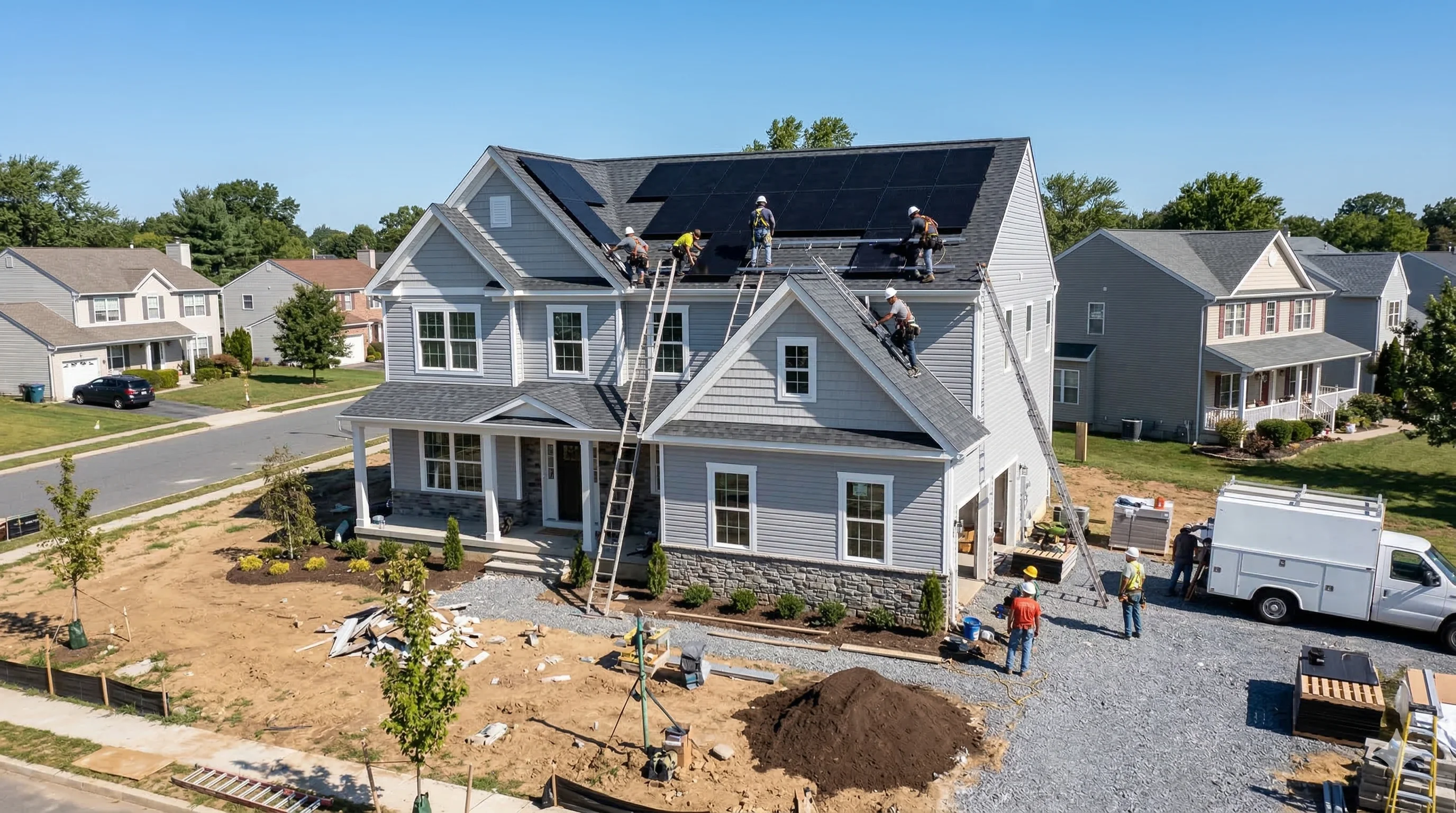
If you’re building a new home in New Jersey, you’re in a position most homeowners never get to be in. You can plan your energy system before a single wall goes up. The roof, the electrical rough-in, and the system sizing can all be designed with solar in mind from day one. The result is a cleaner installation, a better-performing system, and a home built to produce its own energy from the start. Here’s what to know before breaking ground.
Why New Construction Is the Ideal Time to Go Solar
You Control the Roof
On an existing home, the roof you’re working with is the roof you have. Orientation, pitch, age, material, and available surface all come as-is. On a new build, your architect and builder can take solar into account during the design phase. A south-facing primary roof plane at an appropriate pitch can improve production. Minimizing obstructions such as chimneys, dormers, and skylights on solar-facing surfaces preserves usable area. These are easy decisions to make early and much harder to fix later.
Electrical Integration Is Clean and Cost-Effective
In a retrofit installation, getting conduit from the panels to the inverter and from the inverter to the electrical panel often means running wires through finished spaces such as attics, walls, and basements in ways that can be visible, disruptive, or require patching. On new construction, the solar conduit runs can be built into the framing alongside the rest of the rough-in electrical work. Everything is concealed and code-compliant from the start, and the electrician only has to be on site once.
The same logic applies to battery storage and EV charging. If you know you want a battery backup system or a Level 2 EV charger, new construction is the right time to run the wiring for them, even if you are not activating those systems on move-in day. Pulling wire through finished walls later is always more disruptive and more expensive than doing it during framing.
You Size the System to Your Actual Needs
When solar gets added to an existing home, system sizing is usually based on the previous 12 months of utility bills. On a new build, you can design the system around your actual future lifestyle. That means your household size, your appliances, whether you plan to own an EV, and whether you expect to add features like a pool. Getting the sizing right from the start helps avoid leaving production capacity on the table or ending up with a system that does not meet your needs a few years down the road.
We start every project with a consultation that evaluates your energy profile and goals, followed by a site survey that produces an annual production estimate. For a new build, that conversation happens during the planning phase, which is exactly when it should.
Working With Your Builder
The earlier we get involved, the smoother the installation process usually goes. Ideally, we are part of the conversation before the architectural plans are finalized so we can advise on roof orientation and surface area, electrical panel sizing and location, battery and EV charging rough-in, and where conduit chase paths make the most sense.
In practice, we coordinate with your builder’s electrical contractor during the rough-in phase and return to complete the solar installation once the roof is finished and the home is far enough along for the work to be done safely and cleanly. For many projects, the solar installation itself is completed in one day once permits are in hand.
You do not need your builder to already have a solar partner. We handle the coordination directly and work within the construction timeline. If your builder has questions about what is needed during framing, we are happy to be part of that conversation.
The NJ Permit Process for New Construction Solar
Installing solar on a new construction home involves the same general permit categories as any residential solar project. We handle that process for you so you do not have to sort it out alone.
The permits and applications we handle include:
- Zoning and building permits, submitted in coordination with the active construction permit when applicable
- Electrical permit for the solar system and any associated work
- Fire department permit where required by township
- State registration for New Jersey’s residential solar incentive program when applicable
- Utility interconnection application, which is required before the system can be activated and before you can begin receiving net metering credits
The utility interconnection application requires coordination with your utility company. Timing that correctly alongside construction milestones is part of what we manage so activation does not get delayed unnecessarily.
Designing the System: What Goes Into a New Construction Solar Install
Panels
We work with panels from manufacturers including Q-Cells, Panasonic, Silfab Solar, and others, and we offer American-made panel options for homeowners who want domestic manufacturing. For a new build, we recommend a panel based on your roof configuration, your production goals, and your aesthetic preferences. Some homeowners want all-black panels that sit cleanly on a dark roof. Others care more about maximum output per square foot.
Inverters
The inverter converts the DC electricity your panels produce into the AC electricity your home uses. We install systems using inverters from Enphase and SolarEdge, among others. The right choice depends on your roof layout, and we recommend the one that fits your specific design during the planning phase.
Battery Storage
New construction is one of the best times to plan for battery storage. A solar battery system stores electricity generated during the day for use at night or during outages, reducing your reliance on the grid and helping keep your home powered when the grid goes down. New Jersey gets its share of storms and outages, and building a home that is prepared for them is a meaningful upgrade.
A solar battery system includes the panels, an inverter, and the battery itself. Planning for battery storage during new construction means the wiring and space allocation are built in from the start rather than added later.
EV Charging
If you own or expect to own an electric vehicle, new construction is the time to rough in a dedicated charging circuit in the garage, even if you are not installing the charger on day one. Running that circuit during framing is much easier than opening finished walls later. We install EV charging stations and can advise on what should be included during the planning stage.
SPAN Smart Electrical Panel
New construction also gives you the option to install a SPAN smart electrical panel from the beginning instead of replacing an existing one later. SPAN works with solar, battery, and EV charging systems and gives you circuit-level monitoring and control from your phone. You can see how your home is producing and using energy, decide which circuits stay powered during an outage, and manage your system more precisely. Installing SPAN during construction is a much cleaner move than trying to fit it in after the house is finished.
NJ Incentives That Apply to New Construction Solar
Sales tax exemption: Solar systems installed in New Jersey are exempt from the state’s 6.625% sales tax. That lowers the cost from the start.
Property tax exemption: The value added to your home by a solar system is exempt from property tax assessment in New Jersey. The system can add value to the home without raising your annual property tax bill.
Net energy metering: Once your system is activated and connected to the grid, excess electricity your panels generate can earn bill credits that roll over month to month and are reconciled annually.
New Jersey solar incentive program: Eligible residential systems may qualify for the state’s production-based solar incentive program. The exact value can change over time, but the larger point is that this added production-based income can improve the financial return of a solar installation and shorten the payback period. We handle the registration process as part of the installation so your project is set up correctly from the start.
The Long View: Building a Home That Pays You Back Over Time
A new construction home is a long-term asset. Decisions made during design and framing can shape how that house performs for decades. A solar system installed on a new build, sized correctly, integrated cleanly, and built on the right roof, can produce energy for many years with very little maintenance.
Our workmanship is guaranteed for thirty years. That guarantee applies to the installation itself, not just the equipment, and that matters when you are building a home intended to serve you well over the long run.
We have been helping NJ homeowners go solar since 2014, with 1,100+ completed projects and 12 MW of solar capacity installed. If you are building in New Jersey and want to understand what a well-designed solar system could look like for your home and energy goals, we are ready to talk through it.
Get a Free Consultation
You can get a ballpark estimate for your new construction project using our satellite estimate tool at solarmeusa.com, or call us directly at (844) 976-5276 to speak with our team. We are available Monday through Saturday, 7am to 7pm. The earlier in your build process we connect, the more we can do to help set the system up the right way.
The main fixes were the repeated intro, the softened install-timeline claim, and the ADI section no longer locking you into a number that could age badly. Content reads better now and is safer.
